Brooks se retourna de la fenêtre et marcha vers sa chambre. Dans le placard, enterré sous des vêtements civils qu’il n’avait jamais tout à fait habitué à porter, se trouvait une petite boîte en bois. Il le souleva soigneusement, le porta à la table de la cuisine et s’assit.
The box held his memories.
Medals he never displayed. Photographs he rarely looked at. A folded flag from a funeral he still couldn’t talk about. And at the bottom, a faded photograph of twelve men in desert gear, smiling at the camera like they’d live forever.
Onze d'entre eux étaient encore en vie.
Le douzième, c'était Marcus Tillerson.
Brooks a pris la photo et l'a étudiée. Marcus au centre, comme toujours, son bras s'élança autour des épaules des hommes à côté de lui. Ce sourire. Ce sourire ridicule et beau.
« Hé, frère, murmura Brooks. « J’ai rencontré quelqu’un aujourd’hui. Quelqu'un qui était là. »
La photo ne répondit pas. Il ne l'a jamais fait.
La mission était classée depuis des années. Même maintenant, la plupart d'entre eux sont restés enterrés dans des dossiers qui ne verraient jamais la lumière du jour. Mais Brooks se souvenait. Il se souvenait du trafic radio, des appels désespérés, du moment où le monde retenait son souffle et attendait.
Il avait été dans une unité de soutien, à des kilomètres de là, écoutant impuissant au fur et à mesure que le chaos se déroulait. Les voix sur le net – calment au début, puis tendues, puis crues avec quelque chose qui sonnait comme au revoir. Et puis, impossiblement, une nouvelle voix. La voix d’une femme, stable comme pierre, disant: «Nous sortons. Je promets. »
He’d learned later that the voice belonged to a Staff Sergeant named Emily Ward. A medic. A soldier. A ghost who’d climbed into hell and refused to leave without her brothers.
He’d never met her. Never seen her face. But he’d never forgotten her voice.
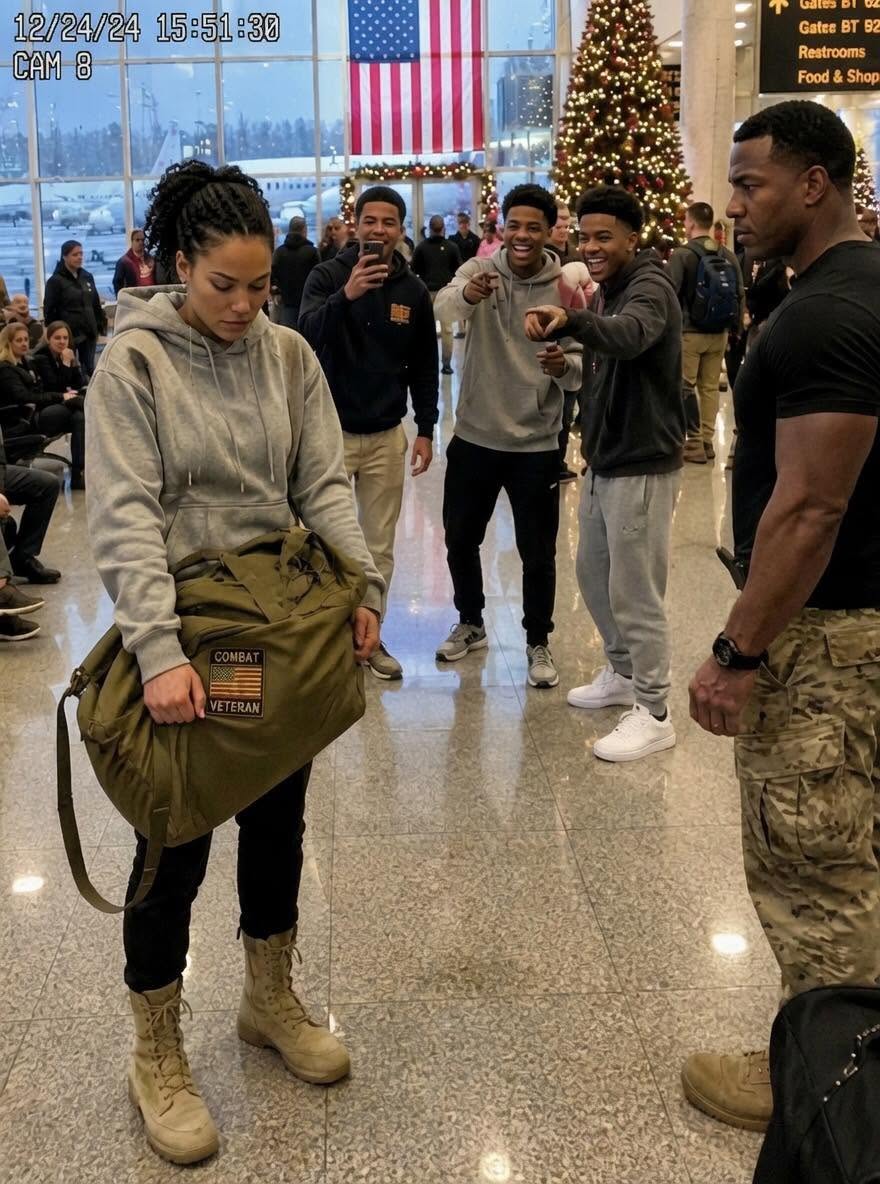
And now, fifteen years later, he’d seen her in an airport. Standing in line. Being mocked by children who had no idea that the woman in the worn hoodie had once held a man’s life in her bare hands and refused to let go.
Brooks set the photograph down and pulled out his phone. He’d saved her number—the one the gate agent had given him, after the salute, after everything. He hadn’t called. Didn’t know what to say.
But tonight, Christmas Eve, he typed out a message:
J'espère que vous l'avez fait à la maison, sergent d'état-major. Brooks ici. Je voulais juste que tu saches, j'ai appelé Powell. Je lui ai dit que je t'avais rencontré. Il a pleuré. Il a dit de vous dire merci. Encore Une Fois. Pour tout. Joyeux Noël.
Il a frappé send avant de pouvoir se deviner.
Her reply came an hour later:
Merci de m'avoir vu. Joyeux Noël.
He read those words over and over. Thank you for seeing me.
Such a simple thing. Such a profound thing. In a world that looked without seeing, judged without knowing, she was thanking him for the most basic human act.
Il posa le téléphone et regarda à nouveau la photo.
« Elle l’a fait, Marcus, » dit-il tranquillement. « Elle est rentrée chez elle. »
The next morning, Brooks woke to the smell of coffee and the sound of his mother humming in the kitchen. He’d flown to Ohio for Christmas, back to the small house where he’d grown up, back to the woman who still worried about him even though he was forty-three years old.
“Morning, Mom.”
She turned from the stove, spatula in hand, and smiled. “Merry Christmas, baby. Sleep okay?”
« Assez bien. »
Elle l’a étudié comme seules les mères peuvent – en voyant au-delà de la surface, directement dans tout ce qu’il essayait de cacher. « Tu as ce regard. Celui que vous obtenez quand vous pensez à des choses dont vous ne parlez pas. »
Il s'est versé du café. « Juste de vieux souvenirs. Rien à craindre. »
Elle l'a laissé partir. Elle l'a toujours fait. Mais il savait qu’elle l’élèverait à nouveau plus tard, doucement, la façon dont elle a tout évoqué – avec patience et amour et la croyance inébranlable que parler a aidé.
Après le petit déjeuner, ils ont ouvert des cadeaux. De petites choses – un pull pour lui, des livres pour elle, le rituel confortable d’une famille qui avait appris à se tenir l’un l’autre lâchement après des années d’adieux.
Puis sa mère lui tendit un paquet plat, enveloppé dans du papier doré.
« C’est venu pour toi la semaine dernière. De quelqu'un nommé Tillerson. Il a dit que c’était important. »
Brooks s'est figé.
He opened the package carefully, his hands steadier than they should have been. Inside was a framed photograph—Marcus, young and alive, standing next to a woman who could only be his mother. On the back, in careful handwriting:
Ryan—I found this in Marcus’s things. He always said you were the brother he chose. Thought you should have it. Love, Margaret Tillerson.
Brooks stared at the photograph for a long time.
His mother sat beside him, quiet, present. She didn’t ask questions. She just waited.
“Marcus,” he finally said. “My friend from the service. He died. A long time ago. Christmas Eve.”
“I remember,” she said softly. “You came home that year and didn’t speak for three days.”
« Il les a sauvés. Il tenait la ligne pour que le reste puisse sortir. Et je n’ai jamais... » Il s’arrêta, avala. « Je n’ai jamais pu dire au revoir. »
Sa mère lui prit la main. « Il savait, Ryan. Les hommes comme ça, ils savent. Ils savent qui les aime. Ils savent ce qu’ils veulent dire pour les gens qu’ils laissent derrière eux. »
Brooks nodded, not trusting his voice.
“Tell me about him,” she said. “Tell me about your brother.”
And for the first time in fifteen years, Ryan Brooks talked about Marcus Tillerson. About his smile. About his laugh. About the way he’d carry extra supplies because he always believed someone would need them. About the night he died, holding a ridge so strangers could live.
When he finished, the sun had moved across the kitchen floor, and his mother’s eyes were wet.
“He sounds wonderful,” she whispered.
“He was.”
She squeezed his hand. “And now you’ve met someone else who was there. Someone who carried his memory all these years.”
Brooks thought of Emily. Of her quiet stillness. Of the patch on her duffel. Of her words: Thank you for seeing me.
“Yeah,” he said. “I did.”
"Alors peut-être que c'est son cadeau pour vous", a déclaré sa mère. « Une chance de se souvenir. Une chance d'honorer. Une chance de faire savoir à quelqu’un d’autre qu’il n’est pas seul. »
Brooks looked at the photograph of Marcus, young and smiling, frozen in time.
« Peut-être », a-t-il convenu.
PART TWO: THE RANGER
David Powell s'est réveillé à 3h47 du matin, comme il l'a toujours fait.
Not from nightmares anymore—those had faded years ago. Just from habit. The body remembers what the mind tries to forget, and his body remembered the cold, the dark, the sound of his own blood soaking into frozen rock.
He lay still, listening to the quiet of his Texas home. Beside him, his wife Maria breathed softly, her hand resting on his chest the way it had every night for the past fourteen years. Through the wall, he could hear the faint murmur of his daughter’s sleep playlist—ocean waves, soft and rhythmic.
They were here. They were safe. They were alive.